
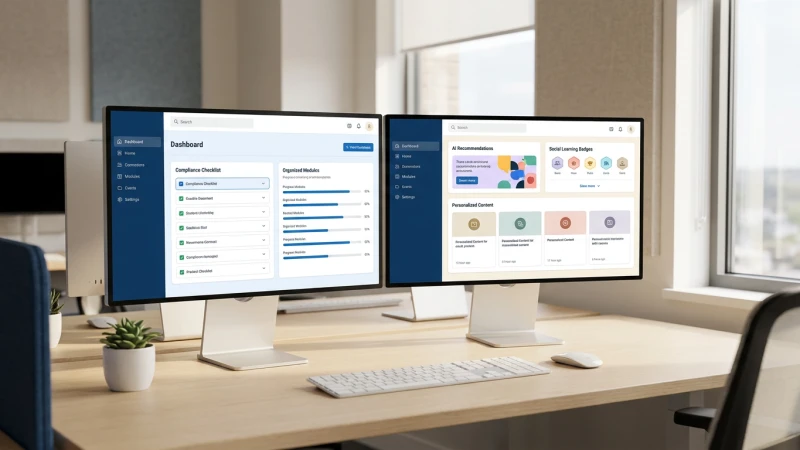
84% of learning platform implementations fail to deliver expected ROI, not because organizations chose the wrong features, but because they asked the wrong questions entirely. The real dilemma isn’t simply LMS vs LXP. It’s about aligning your learning platform choice with your organization’s unique learning maturity and business goals. By reading on, you’ll get a strategic decision framework that ensures you choose a platform that truly fits. Ready to change your learning strategy? You’ll walk away with a decision tree, industry-specific ROI insights, and a 30-day evaluation plan.
Why Most LMS vs LXP Comparisons Miss the Point (And What Actually Matters)
The debate around LMS vs LXP often gets it wrong. Most discussions focus on features, yet 67% of B2B teams agree that feature richness does not guarantee success. The key issue is ensuring the chosen platform aligns with your organization’s learning maturity stage and business outcomes. Ask yourself: Is compliance your primary focus? Or are you aiming to boost learner autonomy and engagement?
Statistics show that 84% of learning platform implementations fail not due to feature gaps but because they lack organizational fit. Misalignment leads to wasted resources and unmet objectives. To succeed, you need to consider three critical factors: compliance needs, learner autonomy, and content strategy. The goal is not to decide between LMS vs LXP but to evaluate your maturity level and business requirements.
| Factor | LMS | LXP |
| Compliance Needs | High | Low |
| Learner Autonomy | Moderate | High |
| Content Strategy | Structured | Curated |
Learning Management Systems: When Structure and Compliance Drive Success
Learning Management Systems (LMS) shine in environments where structure and compliance are critical. Think of industries like healthcare, finance, or manufacturing, where regulations are stringent. LMS offers tracking, reporting, and structured pathways, contributing to a 300%+ ROI in these sectors. For instance, a healthcare organization might use an LMS to ensure every nurse completes mandatory training, reducing compliance risk.
However, don’t overlook the hidden costs. Integration complexity, content creation, and ongoing maintenance can inflate budgets unexpectedly. When considering LMS, factor in these costs to ascertain true ROI. Here’s a quick breakdown:
| Industry | Expected ROI | Hidden Costs |
| Healthcare | 320% | Integration and Compliance |
| Finance | 350% | Content Creation |
| Manufacturing | 300% | Maintenance |
Learning Experience Platforms: When Engagement and Personalization Matter Most
Learning Experience Platforms (LXP) excel in build engagement and personalization. They’re particularly effective in environments focused on skill development and innovation. With AI-driven recommendations, social learning capabilities, and curated content, LXPs offer 67% higher engagement rates than traditional systems, accelerating skill acquisition by 45%.
However, LXPs often fall short in compliance features, which can be a deal-breaker for industries with strict regulatory requirements. Also, maintaining content quality can pose challenges, as user-created content might not always meet organizational standards.
| Feature | LXP | LMS |
| AI-Driven Recommendations | Strong | Weak |
| Social Learning | Enabled | Limited |
| Compliance | Limited | Strong |
The Strategic Decision Framework: Matching Platform to Organizational Reality
Choosing between LMS and LXP shouldn’t be a binary decision. It’s about matching the platform to your organizational reality. Begin with a learning maturity assessment: Is your organization reactive, structured, or strategic? This will guide your choice significantly.
Map your business outcomes to platform capabilities. If compliance is a priority, LMS is likely your best bet. But if you’re focused on skill development or innovation, an LXP might serve you better. Evaluate your resources, IT capacity, content creation ability, change management, and choose accordingly.
| Stage | Description | Recommended Platform |
| Reactive | Focus on immediate training needs | LMS |
| Structured | simplify processes with compliance focus | LMS |
| Strategic | Innovation and skill development | LXP |
Real-World Implementation: 3 Companies That Made the Right Choice (And Why)
Consider these examples of companies that successfully matched platforms to their needs. A manufacturing firm needed to reduce safety incidents. By choosing an LMS, they achieved a 78% reduction. For a tech startup focused on rapid upskilling, an LXP cut their time-to-productivity by 40%. Meanwhile, a financial services company opted for a hybrid approach, integrating both LMS and LXP for a complete learning system.
| Company | Platform Choice | Outcome |
| Manufacturing Firm | LMS | 78% reduction in incidents |
| Tech Startup | LXP | 40% faster time-to-productivity |
| Financial Services | Hybrid | complete learning system |
Beyond the Binary: Hybrid Learning system and Integration Strategies
Some organizations find that one platform isn’t enough. Large organizations with diverse learning needs may benefit from a hybrid system. Integrating LMS and LXP can be achieved through API connections, single sign-on, and unified reporting. This approach provides flexibility, though it requires careful planning and resource allocation.
Consider a cost-benefit analysis to decide between total ownership of one system or a best-of-breed approach combining both. While initial costs may be higher, the long-term benefits often outweigh these expenses.
Making Your Decision: 30-Day Evaluation Process and Vendor Selection Criteria
Ready to make your choice? Follow this 30-day evaluation process. During Weeks 1 and 2, assess organizational needs and gather requirements. Week 3 is for vendor demos using standardized evaluation criteria, ensure you measure engagement, compliance, and personalization capabilities.
In Week 4, focus on designing a pilot program to secure decision-makers buy-in. Use the vendor evaluation scorecard to weigh factors like customer support, user experience, and integration capabilities.
| Week | Activity |
| 1-2 | Assess organizational needs and gather requirements |
| 3 | Vendor demos using standardized evaluation criteria |
| 4 | Design pilot program and secure decision-maker buy-in |