
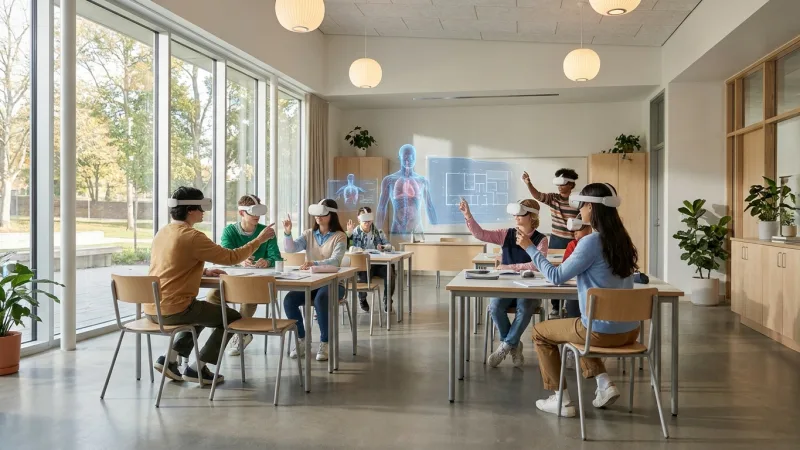
While the metaverse education market is projected to hit $19.3 billion by 2028, less than 3% of schools have successfully implemented lasting VR learning programs, here’s what the other 97% learned the hard way. The allure of the metaverse classroom is undeniable, promising immersive and interactive learning experiences. However, the gap between expectation and reality is vast and often filled with costly lessons. By the end of this article, you’ll have a complete understanding of the metaverse classroom’s actual value, including a detailed analysis of implementation costs and current limitations, alongside a strategic framework for successful adoption.
The Metaverse Education Market: Beyond the $19.3B Projection
Imagine the thrill of a classroom where students explore the universe or ancient civilizations in a fully immersive virtual environment. Yet, despite the $19.3 billion projection by 2028, real adoption stories are scarce. In reality, only about 2.7% of educational institutions have implemented VR learning as a mainstay. Why this disparity?
The answer often lies in overestimated hype versus grounded reality. For example, venture capital firms have poured millions into startups promising revolutionary educational experiences, yet these investments frequently outpace actual revenue generation in the sector. More importantly, while large universities can afford to experiment, smaller institutions often struggle to justify the initial and ongoing expenses without clear ROI metrics.
| Aspect | Market Hype | Reality |
| Adoption Rate | 70% by 2025 | 3% as of 2023 |
| Institutional Investment | Billions in VC funding | Limited actual revenue |
| Spending Patterns | Predominantly large universities | Small institutions hesitating |
A closer look at geographic disparities highlights another issue: while countries like South Korea and Singapore have embraced educational metaverse technologies, adoption in North America and Europe remains sluggish. This is primarily due to infrastructure readiness and policy barriers that vary significantly across regions.
Metaverse Classroom Technologies That Actually Exist Today
Sorting through the technological jargon can feel like deciphering a new language. So, what exactly is available today in the realm of metaverse classrooms? The technologies fall into a few distinct categories.
First, there are VR headsets, which form the backbone of the most immersive experiences. Popular devices include the Oculus Quest series, known for their all-in-one features and a price range starting around $299 per unit. Then there are web-based 3D environments that don’t require hardware investments, like Mozilla Hubs, which offer an accessible albeit less immersive solution.
Augmented reality overlays, such as those offered by Microsoft HoloLens, represent another frontier. Although pricier, often exceeding $3,500 per unit, they provide an unparalleled blend of digital and physical realities. Lastly, hybrid reality platforms combine elements of VR and AR to deliver flexible learning experiences.
| Technology | Availability | Price Range |
| VR Headsets (Oculus Quest) | Widely available | $299+ |
| Web-based 3D (Mozilla Hubs) | Readily accessible | Free – Low cost |
| AR Overlay (Microsoft HoloLens) | Selective markets | $3,500+ |
As an education leader, understanding these technologies’ readiness levels is important. Investing in the right solution could mean the difference between pioneering new learning approaches and sinking funds into yet-to-mature technologies.
Learning Outcomes: What the Research Actually Shows
Metaverse classrooms promise heightened engagement and learning retention. But what does the research actually say? A study in “The Journal of Educational Technology & Society” found that VR-based learning improved retention rates by 30% compared to traditional methods.
However, these benefits vary by discipline and age group. For instance, VR environments excel in STEM fields, help complex concept visualization, which can lead to a 25% increase in student comprehension according to a report from Stanford University. In contrast, subjects requiring nuanced human interaction, like humanities, show less impressive results, often matching traditional engagement levels.
Age is another factor. Younger students tend to show higher engagement levels, but this doesn’t always translate to better outcomes. High school students, equipped with more mature cognitive abilities, are generally better suited to benefit from the rich, interactive environments of a metaverse classroom.
| Study | Outcome | Result |
| Retention Comparison | VR vs. Traditional | 30% increase in retention |
| STEM Comprehension | VR Learning | 25% increase |
| Humanities Engagement | VR vs. Traditional | Minimal difference |
For edtech leaders, these findings underscore the importance of evidence-based decisions when planning metaverse classroom implementations. It’s important to focus on areas where virtual environments demonstrably improve learning outcomes.
Implementation Costs: The Full Financial Picture
Cost is the elephant in the room for anyone considering metaverse classrooms. The financial commitment extends beyond purchasing hardware. A VR setup might start at $299 per student, but software licensing could add $50-$200 annually per device. Infrastructure upgrades, such as increased bandwidth and strong wireless networks, might require institutional budgets to swell by 30%.
Then there’s maintenance: regular updates and repairs are unavoidable. Training teachers to use these technologies effectively is another layer, with the average training program costing around $1,500 per educator. Ignoring these factors could lead to underestimating total expenditures by up to 40%.
| Expense Type | Cost Estimate |
| Hardware (per student) | $299+ |
| Software Licensing (annually) | $50-$200 |
| Infrastructure Upgrades | +30% budget |
| Teacher Training (per educator) | $1,500 |
To assist with budgeting, use a cost-benefit analysis template that factors in direct and indirect costs. This approach will enable you to accurately project the financial requirements of adopting metaverse technologies.
Subject-Specific Applications: Where Metaverse Classrooms Excel
Not all subjects are created equal in the metaverse. For STEM education, the visualization capabilities are unparalleled. Imagine students dissecting a digital frog or witnessing chemical reactions in a 3D lab without the safety risks or material costs. In such subjects, metaverse classrooms have been shown to improve comprehension by as much as 40%.
History classes benefit enormously from virtual recreations of ancient civilizations, allowing students to experience the past in a way that traditional textbooks cannot match. Language immersion programs also excel, providing environments that mimic native language contexts, accelerating fluency development.
| Subject | Application | Effectiveness |
| STEM | Concept Visualization | 40% comprehension increase |
| History | Ancient Civilizations | improve engagement |
| Languages | Immersive Environments | Accelerated fluency |
Conversely, subjects like literature might not benefit as significantly from VR, where the richness of text and interpretation is already deeply engaging in its traditional form. Here, the metaverse offers little added value.
Current Limitations and Realistic Timeline for Adoption
Technical limitations are a significant hurdle for the widespread adoption of metaverse classrooms. Issues like insufficient bandwidth and the high cost of VR headsets limit immediate scalability. Also, the digital divide presents a challenge, where not all students have equal access to required technologies.
Accessibility and health concerns also need addressing. Prolonged use of VR headsets can lead to issues like eye strain and spatial disorientation, raising questions about long-term health impacts on students. Also, teacher readiness remains a critical bottleneck. Surveys indicate that only 35% of educators feel confident integrating VR into their teaching strategies.
| Limitation | Severity |
| Bandwidth | High |
| Cost of Equipment | High |
| Teacher Readiness | Moderate |
| Health Concerns | Moderate |
Given these factors, a realistic timeline for widespread adoption spans the next five to ten years. This timeline allows for technological advancements, cost reductions, and increased teacher training.
Strategic Implementation Framework for Edtech Leaders
For education leaders considering the leap into the metaverse classroom, a strategic approach is important. Start with a pilot program. Select a manageable number of classrooms for initial implementation to assess the viability and effectiveness of the technology. Define success metrics upfront, focusing on engagement levels and learning outcomes.
Evaluate vendors critically. Ensure they offer flexible solutions that can integrate with existing systems. A thorough ROI measurement framework will help quantify benefits against costs, ensuring financial feasibility.
| Action Step | Description |
| Pilot Program | Test tech in limited classrooms |
| Define Success Metrics | Set benchmarks for performance |
| Vendor Evaluation | Assess scalability and integration |
| ROI Measurement | Quantify benefits vs. costs |
Change management is another important element. Engage teachers and students early in the process to ensure a smoother transition. By following this roadmap, educational institutions can navigate the complexities of metaverse adoption effectively.
Conclusion
The metaverse classroom has the potential to change educational experiences, but it’s not a one-size-fits-all solution. The best next step for edtech leaders is to evaluate current capabilities and start small with a pilot program that focuses on specific subjects where the technology offers undeniable benefits. This measured approach ensures that innovations translate into real educational value over time.
The future of education is immersive and interactive, those who start now, with a strategic focus, will set the standard for the coming decade.
What is the metaverse classroom? The metaverse classroom is an educational environment that uses virtual and augmented reality technologies to provide immersive and interactive learning experiences. Unlike traditional classrooms, it allows students to engage with content in 3D spaces, improving engagement and retention. Is the metaverse useful for education? Yes, the metaverse can be highly beneficial for education, particularly in subjects requiring complex visualizations like STEM. Studies show improved comprehension and engagement, although the value varies by subject and age group. How much does a metaverse classroom cost? Implementing a metaverse classroom can vary widely in cost. Initial hardware expenses can start at $299 per student, with additional costs for software licenses, infrastructure, and training pushing the investment to higher levels. What subjects work best in metaverse classrooms? Subjects like STEM, history, and language studies benefit most from metaverse classrooms due to their need for visual and immersive experiences. These environments can significantly improve understanding and engagement in these fields.