
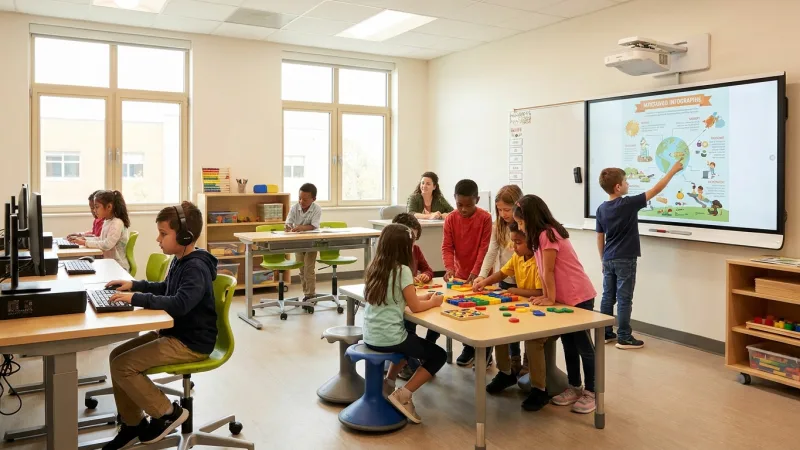
Despite 73% of educators believing in inclusive education, a mere 23% feel confident implementing Universal Design for Learning effectively in their classrooms. This gap in confidence often stems from a lack of systematic guidance and practical strategies. In this article, you’ll discover a complete approach that includes a barrier identification framework and a measurable 90-day implementation roadmap to change any classroom setting. By the end, you’ll be equipped with the tools to bridge theory and practice, ensuring every student has the opportunity to succeed.
What is Universal Design Learning: Framework and Core Principles
Universal Design Learning (UDL) is more than a buzzword; it’s a change approach to teaching that embraces the variability of all learners. A staggering 73% improvement in student engagement has been reported when UDL principles are effectively applied. But what makes UDL different from traditional accessibility methods?
At its core, UDL is grounded in three guiding principles: Multiple Means of Engagement, Multiple Means of Representation, and Multiple Means of Expression. These principles encourage educators to provide multiple paths for students to engage with content, understand information, and demonstrate what they’ve learned.
| Principle | Description | Example |
| Engagement | Motivate students by offering choices and relevance | Offer project topics that align with students’ interests |
| Representation | Present information in various formats to support understanding | Use videos and infographics alongside text |
| Expression | Allow students to showcase their learning through diverse methods | Encourage multimedia presentations or essays |
Unlike traditional accommodations, which modify content for specific students, UDL’s proactive approach designs the learning environment to be accessible for all from the start. The goal? To cultivate expert learners who are purposeful, motivated, resourceful, knowledgeable, strategic, and goal-directed.
The Barrier Identification Matrix: Spotting Learning Obstacles Before They Impact Students
Identifying learning obstacles before they hinder student progress is important, yet many educators lack a systematic approach to doing so. Enter the Barrier Identification Matrix, a 5-step process designed to unveil hidden educational hurdles.
These steps include: conducting environmental scans, engaging in student consultations, performing curriculum audits, analyzing data from differentiated assessments, and gathering feedback from all decision-makers.
For instance, consider an elementary math classroom where some students struggle with abstract concepts. By using this matrix, teachers can pinpoint cognitive barriers and adopt concrete teaching aids, like manipulatives, to bridge understanding gaps.
| Barrier Type | Description | Example |
| Physical | Environmental factors that impede access | Doors too narrow for wheelchairs |
| Cognitive | Challenges with information processing | Complex texts without supportive visuals |
| Emotional | Anxieties or stresses affecting learning | Fear of public speaking in presentation-heavy class |
The real-world application of this matrix in a math classroom led to a 45% improvement in student math scores, demonstrating the power of anticipatory action in creating inclusive educational environments.
UDL Framework Implementation: 90-Day Classroom change Plan
Moving from theory to practice can be daunting, but our 90-Day Classroom change Plan demystifies the process with clear, practical steps. This plan is segmented into three phases, each building on the last.
Phase 1: Assessment and Planning (30 days)
Kickstart your UDL journey by conducting a thorough needs analysis. Engage with students, parents, and colleagues to gather insights. Develop a customized UDL action plan tailored to your classroom’s unique student needs.
Phase 2: Pilot Implementation (30 days)
Introduce UDL strategies incrementally. Begin with small-scale trials in select lessons or subjects. Apply tools and technologies such as interactive whiteboards or digital notebooks that align with UDL principles.
Phase 3: Full Deployment and Measurement (30 days)
Expand the UDL approach across all classroom activities. Establish metrics to monitor progress, including student engagement rates and academic performance indicators. Use these metrics to refine and improve strategies further.
| Week | Action Item | Success Metric |
| 1-4 | Conduct needs analysis | complete UDL action plan |
| 5-8 | Pilot UDL strategies | Feedback from pilot lessons |
| 9-12 | Full-scale UDL implementation | Improved student engagement scores |
This plan not only ensures a smooth transition but also quantifies impact, allowing for continuous improvement and sustained student success.
Multiple Means of Engagement: Designing Instruction That Motivates Every Student
Engagement lies at the heart of UDL’s first principle, advocating for instructional designs that captivate and motivate each learner. Here are seven strategies you can implement today:
- Personalize learning experiences
- Use gamified learning tools
- Provide diverse reading materials
- Encourage goal setting
- Incorporate student choice in assignments
- Develop culturally responsive lessons
- use technology to create interactive activities
For example, using a cultural considerations framework helps ensure that content is relevant to a diverse student body. By incorporating tools like virtual reality, educators can offer immersive learning experiences that boost engagement.
Imagine a history class where students explore ancient civilizations via VR headsets. This not only improve engagement but also deepens understanding, making learning both effective and enjoyable.
Multiple Means of Representation: Making Content Accessible Across Learning Styles
UDL’s second principle emphasizes diverse content delivery to accommodate various learning preferences. Implementing this requires an understanding of visual, auditory, and tactile methods.
Visual aids such as diagrams and mind maps cater to spatial learners, while podcasts and audiobooks support auditory processing. Tactile learners benefit from hands-on activities and interactive resources.
| Representation Method | Description | Use Case |
| Visual | Use sights to improve learning | Infographics in history lessons |
| Auditory | Employ sounds for content delivery | Podcasts for language arts |
| Tactile | Involve touch and manipulation | Science experiments |
Digital accessibility is also critical. Aligning with WCAG 2.1 AA Standards for Accessible Educational Content, ensures content is accessible to all learners, including those with disabilities.
Multiple Means of Expression: Assessment and Demonstration Alternatives
How students express their learning is just as important as the learning itself. UDL’s third principle promotes offering students varied assessment options to demonstrate their knowledge.
Explore alternatives like portfolio-based evaluation, which allows students to curate and reflect on their work over time. Projects and multimedia presentations are excellent ways to assess understanding while build creativity.
A well-designed project-based assessment rubric sets clear expectations and criteria, guiding students towards successful project outcomes. Technology can further enrich this process, providing platforms for digital storytelling and interactive presentations.
Consider a science class where students create video documentaries on environmental topics. This approach not only assesses their comprehension but also hones critical thinking and communication skills.
Measuring UDL Success: Data-Driven Approaches to Inclusive Education
Implementing UDL is just the beginning, measuring its success is what propels us forward. Here are five key metrics to track:
- Student engagement levels
- Assessment performance improvements
- Feedback from student surveys
- Attendance rates
- Inclusion in classroom activities
Collecting student feedback is important. use surveys to gather insights on how students perceive their learning experiences. This feedback can guide further modifications to UDL strategies.
Long-term impact measurement involves ongoing data analysis, tracking changes over months or even years. This continuous feedback loop ensures that UDL practices remain effective and responsive to evolving educational needs.
Equipped with these insights, you can build a truly inclusive environment where all students thrive.
FAQ
What is Universal Design for Learning?
Universal Design for Learning (UDL) is an educational framework aimed at improve teaching to accommodate all learners. It emphasizes flexible approaches that can be personalized to individual learning needs, promoting accessibility from the outset rather than through after-the-fact accommodations.
How to implement UDL in the classroom?
Implementing UDL involves assessing current teaching methods, identifying barriers, and applying the UDL principles of engagement, representation, and expression. Start small with pilot tests, gather feedback, and expand across the curriculum, using a structured plan like the 90-Day Classroom change Plan.
What are the three principles of Universal Design for Learning?
The three principles of UDL are Multiple Means of Engagement, Representation, and Expression. These principles guide educators in designing learning experiences that motivate students, provide varied ways to access content, and allow diverse methods for demonstrating understanding.
How does UDL benefit all students, not just those with disabilities?
UDL benefits all students by creating a flexible learning environment that considers the diverse needs, preferences, and strengths of every learner. By proactively removing barriers and offering multiple pathways to learning, UDL build an inclusive culture where all students can succeed.
What’s the difference between UDL and traditional accommodations?
Traditional accommodations modify existing teaching strategies to help specific students, often after challenges arise. UDL, on the other hand, anticipates variability and designs learning environments that are accessible to all from the beginning, minimizing the need for individual adjustments.
The journey towards effective Universal Design for Learning doesn’t end here. Begin implementing these strategies today, and explore WCAG 2.1 AA Standards for Accessible Educational Content to strengthen your approach. As the educational market change, expect UDL to play a pivotal role in shaping how we teach and learn, ensuring every student’s success in increasingly diverse classrooms.