
Most corporate training programs look healthy on dashboards and underperform in reality.
Completion rates are high. Engagement metrics glow green. Learning calendars stay full. Yet skill gaps persist, ramp times stretch longer than planned, and managers quietly retrain people on the job anyway.
This disconnect is not a motivation problem.
It is not a content problem. Not a people problem. It is a design problem.
Traditional training systems were built to scale content, not capability. In an environment defined by rapid skill decay, AI acceleration, and continuous role evolution, that tradeoff no longer works.
Personalized learning platforms are emerging as a structural upgrade because they align training with how people actually learn and how businesses actually measure value.
This blog explains what personalized learning really is, why it is gaining momentum now, where it creates measurable business impact, and how executives should think about adopting it without falling into hype or pilot purgatory.
The Training Plot Twist Your Workforce Didn’t See Coming
It’s Monday morning. Your team logs into a mandatory training module. Cameras are off. Coffee is half-finished. Slack notifications are firing. Browser tabs quietly multiply in the background.
Nobody skips the training. Nobody rebels. Everyone completes it. From the outside, everything looks fine.
Then a manager asks the only question that matters:
“Can they actually do the thing now?”
That’s where the illusion cracks.
Across enterprise training, SaaS onboarding, compliance programs, and leadership development, the same pattern shows up. Organizations invest heavily in training, yet real-world performance lags. New hires take longer to ramp. Skill application is inconsistent. High performers disengage quietly.
The issue isn’t effort. It’s relevance.
Most training programs are designed for uniformity. Everyone consumes the same content, in the same sequence, at the same pace. It scales well. It just doesn’t work particularly well anymore.
The result is a system where high performers feel slowed down, new learners feel rushed, and managers inherit the cleanup work that the training was meant to prevent.
The result is training that looks productive but doesn’t move the business. What’s changing now isn’t learner behavior. It’s training design.
Why Personalization Is Gaining Momentum Now
Personalized learning isn’t new. The environment is forcing it into relevance.
- Skills decay faster than ever. The World Economic Forum has consistently highlighted the shrinking half-life of skills, especially in digital, technical, and leadership roles. Static training can’t keep up with continuous change.
- Executives want ROI, not attendance. Learning budgets are increasingly tied to productivity, speed to competency, and retention rather than participation metrics.
- AI finally makes adaptation scalable. Advances in machine learning allow platforms to respond to individual learning behavior in real time, without armies of instructors or manual customization.
In the United States, this shift is already visible in large-scale implementations. The Adaptive Courseware for Early Success (ACES) initiative has supported multiple U.S. universities in redesigning high-enrollment courses using adaptive learning systems to improve outcomes while controlling costs.
Personalization is no longer an experimental innovation. It is becoming operational infrastructure.
What Personalized Learning Platforms Actually Are (Not Just Hype)
At its core, a personalized learning platform adapts to the learner instead of forcing the learner to adapt to the system.
That sounds simple. It isn’t.
Traditional learning management systems focus on delivery:
- Did the learner open the module?
- Did they finish the video?
- Did they pass the quiz?
Personalized platforms flip that logic.
They observe how someone learns:
- Where they pause or rush?
- Where errors cluster?
- Which formats sustain attention?
- When confidence spikes or hesitation appears?
Using these signals, the platform dynamically adjusts content sequence, difficulty, pacing, and format in real time.
Under the hood, machine learning models analyze thousands of micro-interactions. Over time, the system builds a learning profile that becomes more accurate with every interaction.
This isn’t about adding AI labels to legacy workflows. It’s about using learning data to remove friction.
Training stops being something that happens to people and starts becoming something that responds to them. That’s why effective personalization doesn’t feel robotic. It feels human.
Training Then vs. Training Now: Two Journeys, Two Outcomes
Training Then (Still the Norm)
In a traditional setup, training follows a fixed path. Everyone clicks through the same modules, watches the same videos, and completes the same assessments. Prior knowledge doesn’t matter. Context doesn’t matter.
Efficient to deploy. Indifferent to outcomes.
Training Now (Time to Adopt)
Now compare that to a personalized learning journey.
- Sam joins with strong foundational knowledge. Early diagnostics detect this, so Sam skips introductory material and moves directly into advanced scenarios.
- Alex is newer to the role. When early signals reveal gaps, the platform slows the pace and reinforces concepts using alternative explanations and practice.
- Jordan learns visually. The system prioritizes diagrams, simulations, and short videos instead of dense text.
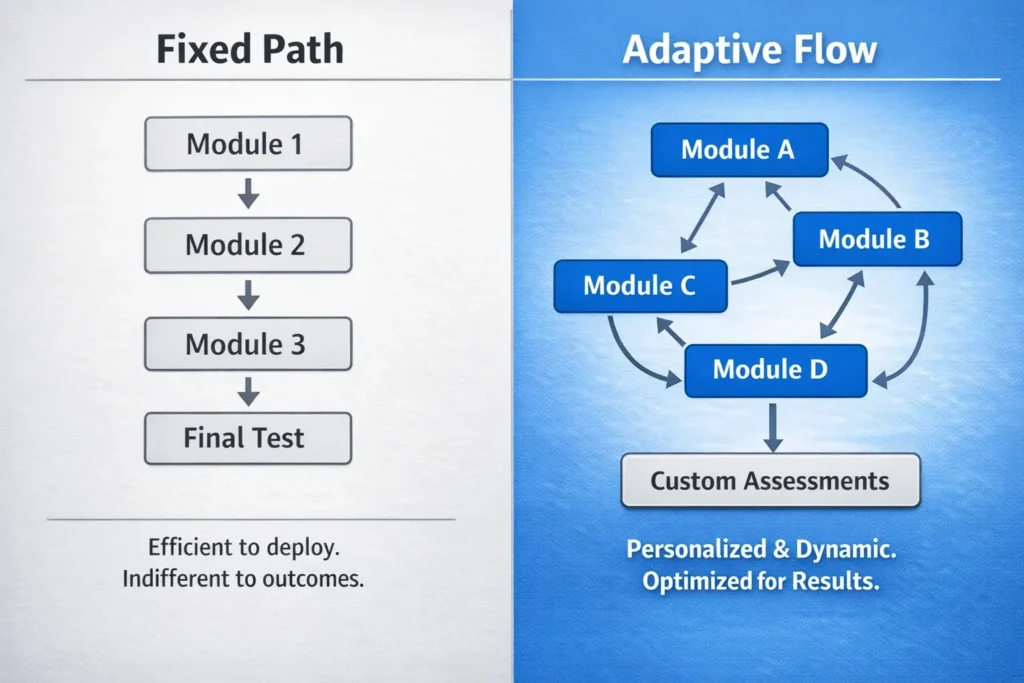
No one is labeled strong or weak. The system simply responds.
U.S. higher-education case studies show that adaptive courseware consistently improves outcomes compared to fixed instructional paths, particularly in large-enrollment courses.
Once learners experience responsive training, generic learning starts to feel like legacy tech.
Evidence That Personalization Works at Scale
Theory doesn’t unlock budgets. Evidence does.
One of the most compelling example comes from Arizona State University (U.S.), where adaptive courseware has been deployed in gateway courses such as College Algebra and introductory biology. In these implementations, adaptive systems have helped personalize learning paths, leading to higher mastery and improved outcomes compared to traditional pathways.
These gains weren’t driven by longer study hours or additional instruction. They came from smarter sequencing and targeted reinforcement.
Beyond single-institution success, the ACES initiative demonstrates that adaptive learning outcomes can be replicated across multiple U.S. universities when implemented intentionally.
The pattern is consistent: personalization improves outcomes without increasing time investment.
Where the Real Business Value Comes From
The true value of personalized learning doesn’t show up first in engagement scores. It shows up in variance reduction.
Traditional training produces wide performance spreads. Some people excel. Others struggle. Managers compensate through coaching, rework, and reassignment. None of this appears on learning dashboards, but all of it costs time and momentum.
Personalized learning reduces that variance by design.
When learners skip what they already know and receive reinforcement exactly where they struggle, high performers accelerate, while developing performers close gaps early. Consistency improves. Predictability increases.
In U.S. virtual university environments, adaptive reinforcement models have been shown to reduce knowledge decay and improve readiness without extending training time.
Time-to-competency becomes a strategic metric. A faster ramp doesn’t just save hours. It accelerates contribution and reduces downstream risk.
Implementation Reality: Why Execution Fails Before Technology Does
Most personalization initiatives fail for reasons unrelated to the platform.
- Content readiness: Personalization requires optionality. Many organizations discover too late that their content libraries are optimized for linear delivery, not adaptive flow.
- Measurement: Legacy success metrics focus on completion and satisfaction. Personalized learning surfaces where learners struggle and where content fails.
- Trust: Personalized platforms collect behavioral learning data. When trust is high, engagement rises. When it isn’t, resistance becomes silent and lethal.
- Role shifts: Trainers aren’t replaced. They’re repositioned. Their value moves from content delivery to insight-driven guidance.
Successful implementations treat personalization not a software rollout.
Internal Buy-In: Turning Insight Into Action
Internal alignment is often harder than platform selection.
Strong cases start with pain leaders already feel:
- Slow ramp times
- Inconsistent skill application
- Managers reteaching what training supposedly covered
External case studies create permission. Internal pilots create belief.
The most effective pilots are framed as risk reduction, not experimentation: one role, one skill domain, and clear before-and-after metrics tied to business outcomes.
Language matters. Personalized learning shouldn’t be positioned as an L&D initiative. It should be positioned as performance infrastructure.
The Decision in Front of You
Personalized learning isn’t inevitable. But the conditions that make it valuable are accelerating.
Skills are changing faster. Roles are blurring. AI is reshaping work itself. Static training models don’t fail loudly. They quietly fall behind while dashboards stay green.
The cost of inaction shows up slowly: longer ramp times, wider performance variance, higher manager load, and disengaged high performers.
Organizations that act now aren’t chasing novelty. They’re building adaptability. They’re creating systems that evolve with roles instead of rebuilding training every cycle.
Personalized learning isn’t just a training upgrade. It’s a strategic one.
FAQs
What is a next-gen personalized learning platform?
It’s a system that adapts content, pace, and format in real time based on how each learner performs, not just what they complete.
How is personalized learning different from traditional LMS training?
Traditional LMSs scale content delivery. Personalized platforms scale capability by adjusting learning paths based on individual behavior and skill gaps.
Why are traditional training programs underperforming despite high completion rates?
Because completion measures exposure, not ability. Learners finish modules, but relevance gaps prevent real skill transfer.
Why is personalized learning gaining momentum now?
Rapid skill decay, ROI pressure, and mature AI have made adaptive learning operationally viable, not experimental.
How does AI enable personalization at scale?
AI analyzes learner interactions to dynamically adjust sequencing, difficulty, and reinforcement without manual customization.