
An employee who has spent five years in a role does not need the same learning journey as someone entering it for the first time.
Yet training programs often have to accommodate both.
The difference may come down to prior knowledge, current skill level, responsibilities, or where the employee wants to develop next. At the same time, every organization has its own processes, systems, terminology, standards, and ways of working that new hires need to understand, regardless of their prior experience.
A useful learning path needs enough structure to establish what everyone must learn, but enough flexibility to avoid teaching the same thing to people who have already mastered it.
That is where learning path customization comes in. Rather than designing an entirely different program for every employee, L&D teams can adjust specific parts of the journey, such as the starting point, skill focus, sequence, level of practice, or next step. The result is a training experience that responds to learner needs without becoming another administrative headache.
What Is Learning Path Customization?
Learning path customization is the process of adapting an employee’s training journey to their existing knowledge, skills, role, development goals, and progress.
Consider two employees moving into customer success roles.
One has years of experience managing customer relationships but is unfamiliar with the company’s product. Another understands the product well but is new to customer-facing work.
Putting both through exactly the same sequence may cover everything the role requires, but it also means one person could spend hours revisiting skills they already have while the other needs more support in a different area.
A customized learning path can change where they begin, which topics receive more attention, and what they tackle next.
Microsoft’s Viva Learning, for example, provides personalized learning recommendations that can change as employees search for and complete training.
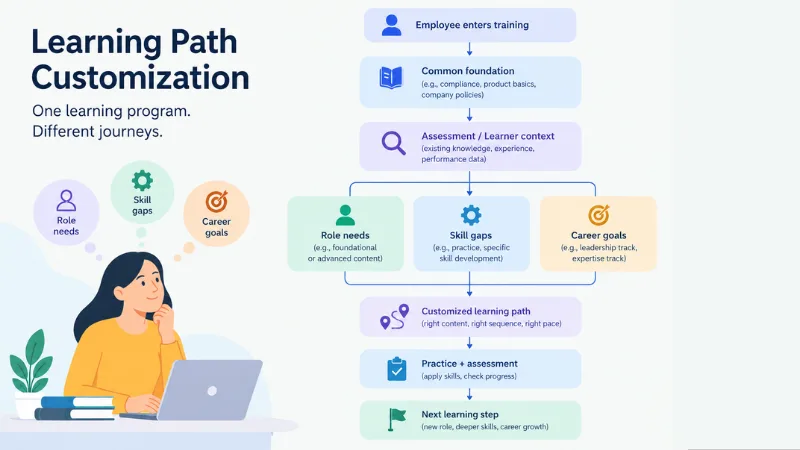
Learning path customization for personalized employee training journeys
Why Does Learning Path Customization Matter?
Personalization is useful when it solves a real learning problem.
Think about an experienced employee who already understands the fundamentals, a new hire who needs more guided practice, and someone preparing for a completely different responsibility. Giving all three the exact same journey may be simple to administer, but it is not necessarily the most useful way to develop them.
There is evidence that learners want training to feel more relevant. LinkedIn reports that 78% of learners expressed a need for course recommendations based on their career goals and skill gaps, while companies recommending courses on LinkedIn Learning saw 69% more hours watched per learner.
The goal is not to make every learning experience different. It is to make the parts that matter more relevant.
What Can You Customize in an Employee Learning Path?
The most effective approach is selective. Some elements of training need consistency, while others can respond to individual needs.
Starting point
Not every employee needs to begin with the introductory module.
Prior experience, previous training, certifications, assessments, and demonstrated knowledge can help determine where someone should enter the learning path.
For example, if an employee demonstrates competency in a required skill during an assessment, they can move to the next stage instead of repeating content they have already mastered. LMS platforms such as Docebo and Cornerstone can help organizations manage different learning paths around learner needs.
Skill focus
Two people in the same role can struggle with completely different things.
Take two sales employees. One may have trouble uncovering customer needs during discovery calls, while the other knows the product well but needs more practice handling negotiations.
A skills gap analysis can help identify these differences before training is assigned.
Career direction
The next role an employee is working toward can change what they need from training.
Someone preparing for a management position may need practice with coaching, delegation, and performance management. Someone looking to deepen expertise in their current field may be better served by advanced technical or functional learning.
LinkedIn’s career development guidance connects employee development with individual career goals as well as organizational needs.
Sequence and depth
Sometimes the content does not need to change at all. The order or amount of practice can.
An employee who performs strongly in a product assessment might move straight into customer scenarios. Another learner may need another round of practice before making the same jump.
The content stays largely the same. The learner simply does not spend the same amount of time on every part of it.
Learning format
The format can also change depending on what the learner needs to do.
Someone learning a software workflow may benefit from a hands-on simulation rather than another video lesson. A manager learning how to handle a difficult employee conversation may get more from a role-play than another slide deck.
For organizations delivering live or instructor-led training, choosing the right virtual classroom platform can also affect how that part of the learning path is delivered.
Platforms such as Udemy Business allow organizations to combine courses with custom content and other resources within learning paths.
The important question is not which format is most popular. It is which format helps the learner develop the required capability.
What Should Stay the Same?
Customization needs some boundaries.
Certain learning requirements should remain consistent across a group of employees. These may include:
- Compliance requirements
- Company policies
- Product fundamentals
- Core processes
- Required systems
- Baseline role competencies
These create the foundation employees need to work within the organization.
The flexibility can come after that foundation is established. Employees can then move into different modules based on their experience, skills, responsibilities, or development goals.
This also makes customized employee training easier to maintain. L&D teams do not have to rebuild the curriculum every time someone new joins.
What Does a Customized Learning Path Look Like?
Consider a software company onboarding customer success managers.
Everyone needs to understand the company-specific essentials, such as the product, customer lifecycle, internal systems, and communication standards. But a learner who already knows customer lifecycle management may need less practice with the concept itself, while someone new to the role may need more guided scenarios.
From there, the learning path can branch based on what each employee needs next.
- A new CSM might spend more time on account-management fundamentals and customer scenarios.
- An experienced CSM might move into renewal strategy, expansion conversations, and complex customer situations.
- An aspiring manager might take modules on coaching, delegation, and performance management.
- Someone with a product knowledge gap might spend more time on product training and simulations before continuing.
The learning program remains one program. Employees simply take different routes through it.
How Do You Know If Customization Is Working?
A learner can complete every assigned module and still struggle to handle a real customer escalation. That is why completion alone does not tell the whole story.
L&D teams can look at:
- Time to competency: How quickly does the learner reach the required skill level?
- Assessment performance: Can the learner demonstrate what they have learned?
- Skill application: Are the skills being used in real work?
- Performance: Has relevant job performance improved?
- Progression: Is the employee developing toward the intended role or capability?
- Engagement: Are learners using and completing the training assigned to them?
The learning technology should support this process too. An LMS platform needs to accommodate the structure, assessments, learner data, and progress tracking required by the learning strategy.
The useful question is simple: did the customized path help the employee develop the required capability more effectively?
How to Make Learning Path Customization Work
Start with the capabilities employees need to perform their roles well. Then use assessments, experience, performance, and development goals to decide where additional support or flexibility is useful.
A practical approach is to:
- Define the common foundation every learner needs.
- Assess existing capability before assigning the full journey.
- Create clear branching points for different needs.
- Use real performance data to adjust the path over time.
- Review the paths regularly as roles, systems, and business requirements change.
An LMS can help L&D teams manage these different routes, track learner progress, and update training as requirements change.
The result is a learning path that gives employees what they need without making L&D teams manage a completely different program for everyone.
Frequently Asked Questions (FAQs)
Q1. What are the challenges of personalized learning paths?
Common challenges include collecting reliable learner data, keeping multiple learning routes updated, deciding how much personalization is useful, and avoiding overly complicated training structures. Organizations also need clear rules for when a learner should move forward, repeat material, or take a different module.
Q2. How does AI personalize employee training?
AI can use learner activity, assessment results, skills data, and training history to recommend or prioritize learning content. Depending on the system, it may also help identify skill gaps, suggest what an employee should learn next, or adjust recommendations as the learner’s needs change.
Q3. Should employees be allowed to choose their own learning paths?
Employee choice can work well for development areas where learners have different interests or career goals. It may be less appropriate for mandatory training or skills that are essential to a specific role. A combination of required learning and controlled choice gives employees flexibility without removing necessary structure.
Q4. What is the difference between adaptive learning and customized learning paths?
Adaptive learning typically changes the learning experience based on a learner’s responses or performance, often during the training itself. Learning path customization can be broader, changing which courses, modules, activities, or development opportunities a learner receives across the overall training journey.
Q5. How often should employee learning paths be updated?
There is no single schedule that works for every organization. Learning paths should be reviewed when roles, processes, products, technology, or required skills change. Learner performance can also indicate that a path needs adjustment before its next scheduled review.