Imagine choosing an e-learning standard that costs you an extra $127,000 within two years. That’s what 73% of organizations face when they pick the wrong standard, a costly mistake that’s completely avoidable. This guide provides a practical decision matrix, complete with a cost-benefit analysis and real implementation timelines, to help you make an informed choice between SCORM and xAPI. You’ll walk away with a clear understanding of which standard aligns best with your organizational goals.
The Hidden Costs of Choosing the Wrong E-Learning Standard
Choosing the wrong e-learning standard is more than a technical glitch, it’s a financial disaster. Migration expenses for e-learning content can range from $50,000 to $200,000 depending on your content library’s size and complexity. For instance, if your training modules are deeply integrated with a Learning Management System (LMS), switching standards often leads to re-engineering content. Imagine the disruption to your training schedules and a dip in learner engagement!
Take Company X, a tech firm that adopted SCORM without evaluating future needs. Within 18 months, their content was outdated, requiring a transition to xAPI at a steep cost of $150,000. Not only did they face direct expenses, but the constant transition also impacted their ROI, delaying project launches and negatively affecting overall productivity.
| Migration Aspect | Estimated Cost |
| Content Re-engineering | $30,000 – $80,000 |
| Training Personnel | $10,000 – $25,000 |
| System Downtime | $10,000 – $50,000 |
Being locked into a vendor’s technology stack without the flexibility to adapt to evolving needs severely limits your growth potential. It’s time to understand these standards before making a choice.
SCORM Standard Explained: Capabilities and Current Limitations
If you’ve been in the e-learning space, you’ve surely come across SCORM. While it’s been a staple, SCORM isn’t without its limitations. SCORM 1.2 and 2004, the two main versions, offer differing levels of detail in tracking learner interactions. However, both face compatibility issues with newer browsers and limitations in mobile learning environments.
SCORM 1.2, widely adopted due to its simplicity, lacks the detailed tracking offered by SCORM 2004, which includes sequencing and navigation features. Despite these capabilities, SCORM remains constrained in offline environments, making it less suitable for today’s on-the-go learners. Notably, it’s dependent on the LMS for data storage, which can be a bottleneck for organizations seeking extensive real-time analytics.
| SCORM Version | Key Features | Compatibility |
| SCORM 1.2 | Basic tracking, Limited compatibility | 80% LMS, 65% browsers |
| SCORM 2004 | Sequencing, Navigation, Advanced tracking | 70% LMS, 60% browsers |
While SCORM’s ability to integrate with traditional LMSs is significant, its constraints in modern, cross-platform learning environments necessitate a deeper dive into modern standards like xAPI.
Experience API (xAPI) Deep Dive: Beyond Traditional LMS Boundaries
xAPI, also known as Tin Can API, transcends traditional LMS limitations by enabling learning data to be captured from any platform. Imagine tracking learner activities across different environments, web, mobile, virtual reality, and storing those interactions in a Learning Record Store (LRS).
The structure of xAPI statements, such as “John completed course,” allows for detailed activity recording. This flexibility can change your data capabilities, providing real-time analytics and personalized learning experiences. Unlike SCORM, xAPI supports offline tracking, adding a layer of convenience for remote learners.
Also, xAPI’s security features and its ability to integrate with various data system make it a formidable choice for companies looking to expand their learning architecture. Explore further insights into how xAPI is change the learning standards market.
| LRS Vendor | Unique Features |
| Vendor A | Real-time data, Cross-platform tracking |
| Vendor B | Advanced analytics, Full SCORM support |
xAPI’s strong architecture and scalability offer a modern solution for complete learning system, aligning well with forward-thinking educational strategies.
Head-to-Head Comparison: SCORM vs xAPI Feature Analysis
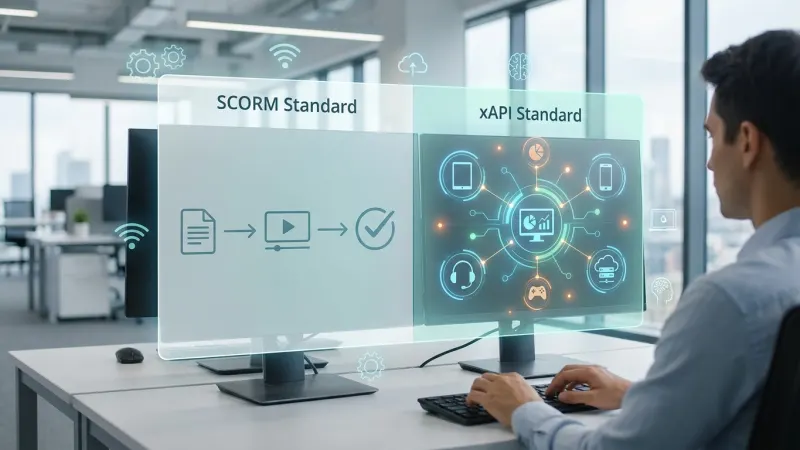
When comparing SCORM and xAPI, understanding feature differences is important for decision-making. Tracking granularity is a critical factor. While SCORM tracks completion and success, xAPI dives deeper, capturing every learner interaction, whether online or offline.
Content portability is another key consideration. SCORM packages content in a way that’s largely LMS-dependent. In contrast, xAPI content can exist outside the confines of an LMS, offering greater flexibility and ease of access across devices. The scalability and security of xAPI further improve its appeal for organizations prioritizing data integrity and future expansion.
| Feature | SCORM | xAPI |
| Tracking Granularity | Basic (completion) | Advanced (detailed tracking) |
| Content Portability | LMS-dependent | LMS-independent |
| Security | Basic | Advanced (encryption) |
| Scalability | Limited | High (dynamic scaling) |
In terms of performance, xAPI’s real-time data capabilities provide a more strong infrastructure for analytics and decision-making, making it a strong contender for organizations with complex learning environments.
The Decision Matrix: Which Standard Fits Your Organization
Determining the right standard requires a tailored approach. The decision matrix presented here evaluates factors like organizational size, budget, technical capacity, and strategic alignment. Small teams may find SCORM sufficient due to its simplicity, whereas larger entities with complex training needs might lean toward xAPI.
Consider your budget and technical resources. SCORM’s lower initial cost is attractive for leaner budgets, but xAPI’s long-term benefits might outweigh upfront expenses. Alignment with your learning strategy is equally pivotal. Does your company focus on real-time analytics and cross-platform learning? If so, xAPI is the obvious choice.
Use this ROI calculator framework to quantify potential returns and make a data-driven decision that aligns with your organizational goals.
Implementation Roadmap: From Standard Selection to Deployment
Once you’ve chosen a standard, the next step is strategic implementation. Start with a pre-implementation audit to identify potential gaps in your existing systems. This step ensures a smooth transition and prepares your team for change.
Training requirements are important for both SCORM and xAPI. Ensure your team is well-versed in the chosen standard to prevent costly errors. Content migration strategies must be carefully planned, with testing protocols established to validate the new system’s performance and reliability.
| Deployment Phase | Timeframe |
| Pre-Implementation Audit | 1 Month |
| Content Migration & Testing | 3 Months |
| Training & Rollout | 4 Months |
| Full Deployment | 4 Months |
Allocating resources effectively across these phases is key to a successful implementation. Follow this roadmap to transition smoothly and maximize your e-learning platform’s potential.
Future-Proofing Your Choice: 2024-2026 E-Learning Standards Roadmap
As we look to the future, understanding emerging e-learning standards like cmi5 and their potential to complement or replace existing ones is important. Adoption trends show a growing shift toward flexible, flexible solutions that can adapt to technology advancements.
Staying informed about backward compatibility ensures your investments remain protected. Industry statistics reveal that organizations prioritizing future-proof strategies experience 30% less disruption during technology transitions. Position your organization to thrive by adopting standards that not only meet current needs but also anticipate future demands.
For a deeper dive into xAPI vs SCORM and emerging standards, visit our complete guide.
Conclusion
The choice between SCORM and xAPI isn’t merely a technical decision, it’s strategic. Decide today by assessing your organizational needs against the decision matrix and use our implementation roadmap to guide your path. For further insights, explore our resources on xAPI and SCORM compatibility.
What is SCORM? SCORM, or Shareable Content Object Reference Model, is a set of technical standards for e-learning software products. It determines how online learning content and LMSs communicate, primarily focusing on content compatibility and tracking completion. What is the main difference between SCORM and xAPI? The main difference is in tracking capability. SCORM focuses on completion and success rates, while xAPI provides detailed tracking of every learner interaction, including offline activities, across various platforms and environments. Is xAPI replacing SCORM? No, xAPI is not replacing SCORM but rather offering a more flexible and complete alternative. Many organizations adopt xAPI for its advanced analytics and cross-platform tracking, yet SCORM remains a viable option for simpler implementations. Which is more cost-effective: SCORM or xAPI? SCORM is often more cost-effective initially due to its simplicity. However, xAPI can offer greater long-term value by supporting detailed analytics and future-ready learning architectures, which can result in significant ROI. Can SCORM and xAPI work together? Yes, SCORM and xAPI can coexist. Many organizations use SCORM for basic tracking needs and supplement it with xAPI to capture more detailed learner data and analytics, use the strengths of both standards.