
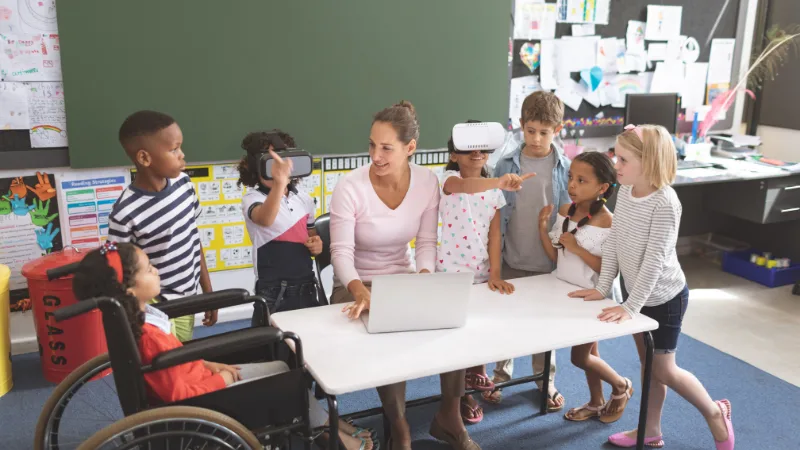
Education has always been a quest to open doors for every learner. For students with special needs that quest comes with unique hurdles in communication, movement, perception, and cognitive processing. Technology, when designed inclusively, becomes more than a tool. It transforms into a lifeline that levels the playing field. This is where educational technology, or EdTech, carries both promise and responsibility. Far from being gadgets for classrooms, EdTech solutions designed with accessibility at their core embody the principles of equality, empathy, and human flourishing.
At its heart, accessible technology rests on a daringly simple question: what if every learner had the chance to succeed, not in spite of their differences but with them in mind? Traditional classrooms sometimes turn differences into disadvantages. Fonts too small, videos without captions, or assessments designed only for conventional responses create invisible walls. Accessibility reframes the classroom into a flexible canvas, adaptable to diverse needs.
This philosophy builds on the universal design for learning (UDL). Instead of retrofitting accommodations, UDL insists that education should be designed from the start with variability in mind. EdTech, capable of customization and personalization at scale, provides fertile ground for UDL in practice.
Types of Supportive Technologies
Accessible EdTech spans a vast toolkit. It is not confined to one category of disability but stretches across sensory, cognitive, physical, and emotional domains.
Key Categories of Accessible EdTech |
||
|---|---|---|
| Need Area | Technology in Action | Examples of Application |
| Visual Impairment | Screen readers, audio textbooks, tactile displays | Students can access texts via speech synthesis or braille |
| Hearing Impairment | Captioning tools, sign-language avatars, hearing aid integration | Lecture videos gain real-time captions |
| Cognitive Support | Text simplification, memory aids, adaptive pacing | Reading apps that break down long sentences |
| Motor Challenges | Eye-tracking software, speech-to-text, adaptive keyboards | Students control learning without hands-on typing |
| Emotional/Behavioral | Gamified engagement, self-regulation apps | Tools reduce anxiety and break lessons into manageable steps |
Each row in this table is more than technical jargon. It represents lives transformed through small adjustments that honor learning individuality.
Psychological Implications
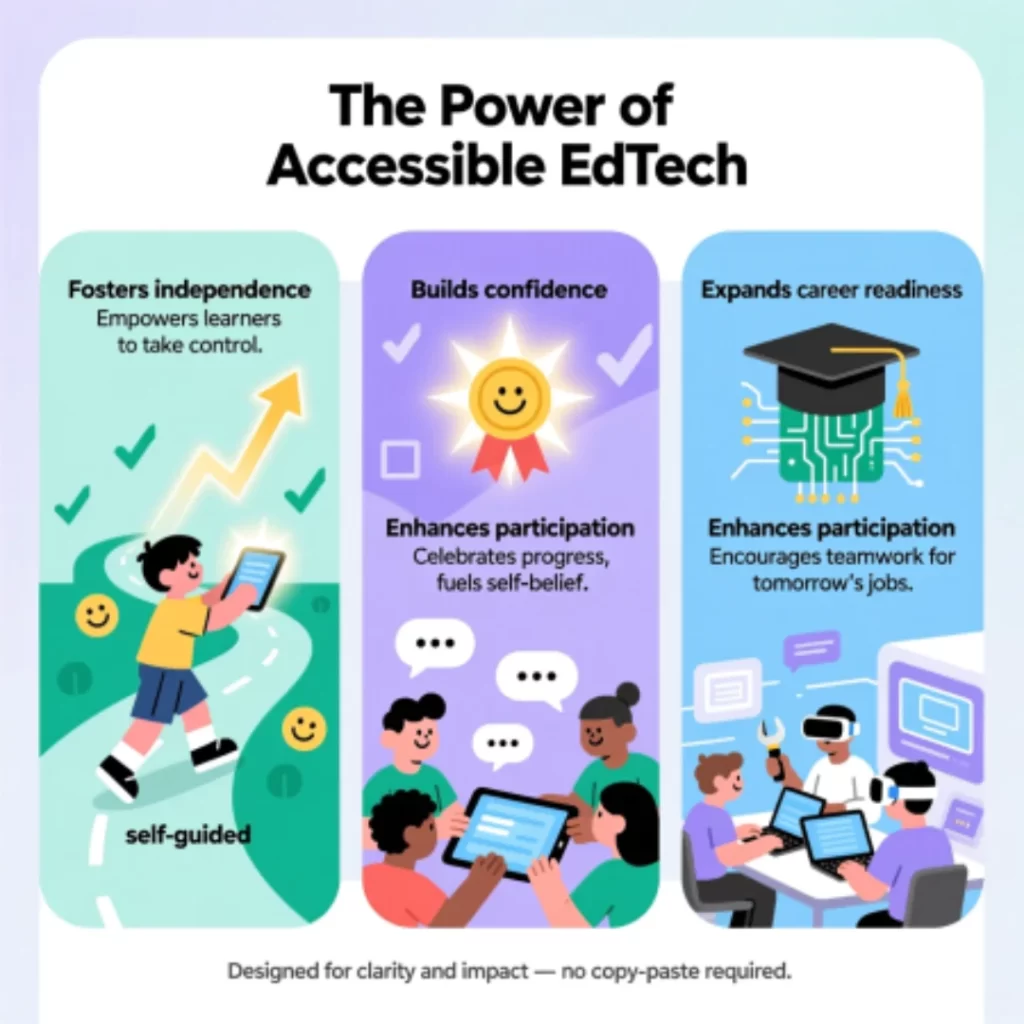
Using assistive technology does more than deliver information. It strengthens identity and self-esteem. Imagine a learner who spends years struggling to read standard print now accessing entire libraries through a screen reader. The psychological shift is immediate: frustration transforms into achievement, alienation into belonging.
But accessibility is not one-way empowerment. Students with special needs often encounter emotional fatigue from constantly “working harder” to keep up. EdTech reduces this cognitive load. It frees mental space for higher learning instead of endless coping. This relief fuels resilience, a priceless psychological asset for lifelong growth.
Generational Perspectives
Generational divides also shape experiences of accessible EdTech. Older adults with late-onset disabilities may find adaptive tools daunting at first. Yet for younger learners born into technology, assistive apps become second nature. Teachers too exhibit generational contrasts. Some embrace tools like speech-to-text with enthusiasm, while others hesitate, fearing replacement of traditional learning.
If schools ignore these divides, they risk either alienating students or overburdening teachers. Success comes when institutions view all users as learners in transition. Training for educators alongside students builds shared confidence, reducing the psychological stigma surrounding assistive tech.
The Role of Schools and Educators
Schools must not treat accessible EdTech as an add-on. It should anchor the moral mission of inclusive education. Teachers need both training and time to integrate systems without feeling rushed. Administrators must see investment not as charity but as infrastructure.
When deployed holistically, accessible EdTech can influence broader pedagogy. Voice feedback benefits dyslexic students but also boosts writing fluency for non-disabled peers. Captioning boosts comprehension not only for the deaf but also for language learners. Accessibility enhances education universally, making classrooms smarter for all.
Misconceptions and Barriers
One barrier to adoption is the misunderstanding that accessibility is expensive or niche. Schools sometimes fear high cost, yet many high-impact tools are baked into mainstream devices. Speech-to-text and magnification now sit inside most operating systems. Another barrier is stigma. Students may avoid assistive devices fearing they “look different.” Normalizing accessibility as part of daily practice dismantles those fears.
Infrastructure challenges also persist. While a wealthy urban school may afford tablets with advanced accessibility, underfunded rural schools still struggle to provide stable electricity or internet. The digital divide here is not just about connection but about justice.
Consider a student with cerebral palsy using eye-tracking software to compose essays. This technology not only delivers learning outcomes but also reshapes peer perception. Other students witness ability, not disability.
Another case:
captioning tools in a mainstream classroom. Hard-of-hearing students rely on them, but peers benefit as well. A noisy environment or a teacher with a strong accent no longer hinders understanding. Here, accessibility multiplies into universal benefit.
Ethical Dimension
Education carries a duty not just to transmit knowledge but to safeguard dignity. Failing to provide accessibility is not merely a practical oversight. It is an ethical lapse. Denying a student the tools of participation effectively denies them their right to equality. Accessible EdTech is therefore not an act of generosity. It is an act of justice.
Ethics also extend to privacy. Data-rich applications must guard against misuse. When EdTech designed for vulnerable learners collects sensitive information, its custodians must uphold strict standards of protection. The goal is empowerment, never exploitation.
Role of Policy and Collaboration
Governments and institutions can magnify the power of EdTech through structural support. Subsidies, training programs, and explicit accessibility requirements in procurement policies are key levers. Collaboration with private innovators further accelerates the creation of tools tailored for diverse conditions.
Parents, caregivers, and medical professionals also shape the ecosystem. A coordinated effort ensures that classroom experience aligns with therapeutic practices and daily life. Students then experience continuity instead of fractured support.
Looking Ahead
The next decade will see immersive technologies, artificial intelligence, and wearable devices redefining accessibility. AI-driven individualized learning could fine-tune reading speed or content complexity for each learner. Virtual reality could simulate safe spaces for students with anxiety to practice participation. Wearables could monitor and regulate stress in real time.
The horizon is not free of challenges, but the trajectory is clear. Accessibility is no longer peripheral rhetoric. It is now central to defining meaningful education in the digital age.
Accessible EdTech is education’s bold declaration that no learner shall be left unattended or underestimated. It shifts focus from programs that compensate for deficits to platforms that amplify strengths. It bridges generational gaps, dissolves stigma, and transforms psychological burden into self-belief.
A school that invests in accessibility is not only equipping students with special needs to participate. It is training every learner, teacher, and citizen to see diversity as capacity. Accessibility in EdTech does not whisper of inclusion. It speaks of justice in action.