
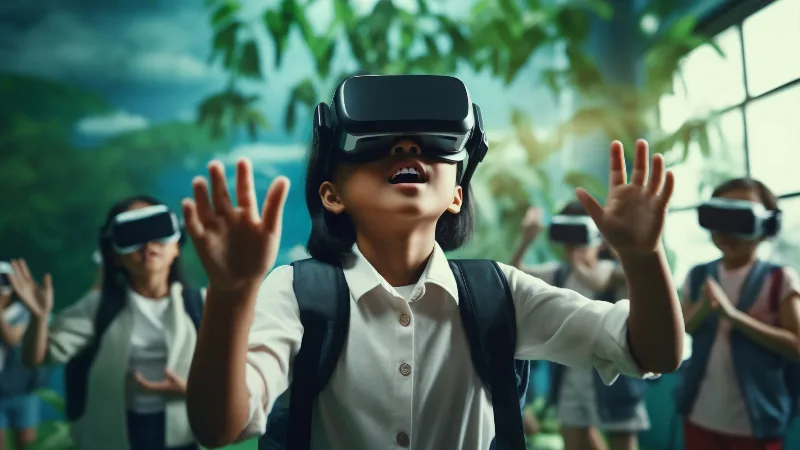
If you stepped into a classroom from 1924 and compared it to a classroom in 2024, you’d probably notice that a lot looks familiar: desks, a teacher at the front, maybe a chalkboard swapped out for a projector screen. But now imagine a child sitting not just at a desk, but in Ancient Egypt exploring the pyramids, or inside the circulatory system watching red blood cells rush past. This is the future virtual reality (VR) education is making possible. Far from being just a novelty or a video game accessory, VR is quietly reshaping the very way we learn, teach, and engage with knowledge.
Virtual reality in education is a revolution in slow motion: it’s still early, but the changes already happening are dizzying. Let’s take a closer look at how VR is transforming classrooms and what the future may hold.
Why VR Has Landed in Education
Technology has always been a restless traveler in education. First came chalkboards, then slides, then computers, and eventually tablets. VR is the latest waypoint, but it stands out because it doesn’t merely provide access to information. It provides experience.
At its core, VR gives us:
– Immersive environments: Students don’t just read about the solar system; they can float among the planets.
– Active participation: Instead of memorizing anatomy terms from a textbook, students can peel back digital muscle layers and interact with 3D organs.
– Emotional engagement: Experiences stick better when they spark awe, wonder, or curiosity and VR nearly always does.
Where traditional education presents knowledge in two dimensions, VR wraps it around students like a living quilt of experience.
The Classroom Reimagined
Picture a typical Monday morning science class. Instead of opening to page 142 on “Volcanoes of the World,” students slip on lightweight VR headsets. In seconds, they’re standing inside a simulation of Mount Vesuvius right before it erupts. They can feel the rumble (haptics technology even makes the ground tremble), watch the progression of smoke clouds, and safely “walk” through Pompeii to see the devastating impact.
This isn’t sci-fi, it’s already happening in pilot classrooms in Europe, the U.S., and Asia. Google Expeditions, Curiscope, and ClassVR are examples of platforms that give teachers the ability to take students on field trips without buses, permission slips, or geography holding them back. A class seated quietly in New Jersey today may walk the Great Wall of China tomorrow.
Learning by Doing Instead of Memorizing
The magic of VR is its ability to move us from rote learning to active, experiential learning. Neuroscience tells us again and again: the brain retains knowledge better when it’s experienced.
Take language learning. Instead of memorizing a tediously long vocabulary list, VR allows students to enter a Parisian café, order a croissant, and hear immediate feedback. Suddenly, speaking French becomes communication in context.
Or think about history. Rather than reading a dry overview of the civil rights movement, a VR experience can place students in a 1960s march, allowing them to hear speeches and feel the collective energy. That immediacy deepens empathy, which textbooks alone rarely achieve.
The educational philosopher John Dewey once said, “Give your pupils something to do, not something to learn.”
Skills for the Real World
Beyond traditional academic subjects, VR is also building bridges between classrooms and real-world jobs. Vocational training has become one of its most promising areas.
For example:
– Medical Training: Students can practice complex surgeries in VR without risk to patients. Mistakes become learning tools rather than disasters.
– Engineering & Architecture: Learners can build and manipulate 3D structures, walk through buildings before they exist, and test designs in simulated environments.
– Technical Trades: Aspiring electricians or mechanics can tinker with simulated machinery. If something goes wrong, sparks don’t fly, except maybe digital ones designed to teach the danger.
Employers are increasingly favoring candidates who can translate classroom knowledge into workplace expertise. VR effectively shrinks that “theory-to-practice” gap.
Accessibility and Inclusion
At first glance, VR might seem like a luxury toy. Something that was out of reach for most schools. But here’s the twist: it has huge potential for improving equity.
For students in remote areas, or schools with limited budgets for field trips and hands-on labs, VR can deliver experiences they’d never otherwise have. A small school in rural India can now take its kids to the Louvre, just as a wealthy suburban district might.
Moreover, VR has significant promise for students with disabilities. A wheelchair user, for instance, can explore Machu Picchu in VR without physical barriers. Students with attention challenges often find VR’s focus and immersion helps keep them engaged without the distractions of the typical classroom.
That said, inclusion isn’t automatic. Schools and developers will need to be intentional about designing VR tools to ensure that hardware and software remain accessible. Pricing, comfort, and user interfaces all matter.
Challenges We Need to Solve
Alright, before we all start high-fiving about how VR is the cure-all for education, it’s worth pausing to consider the hurdles.
- Cost: High-quality VR headsets and software can be expensive. A single headset may cost several hundred dollars, and a class set could run into thousands. While costs are dropping, it’s still a barrier for underfunded schools.
- Content Development: Creating effective VR learning modules takes careful design. We can’t just dump PowerPoint slides into a VR headset and call it innovation. Teachers, historians, scientists, and designers must collaborate to ensure accuracy and engagement.
- Teacher Training: Technology is only as effective as the people using it. Educators need training to integrate VR meaningfully, not just as a techy sideshow.
- Health & Safety: Extended use of VR can cause motion sickness or eye strain for some students. Balancing immersion with physical well‑being is essential.
- Equity: The promise of VR to make learning more accessible won’t materialize if only the best‑resourced schools can afford it. We risk creating a new digital divide unless access is broadened deliberately.
Like any tool, VR is neither magic nor menace. It’s about how we implement it.
A Peek Into the Next Decade
So where is this all going? Here are a few likely trends that will define the coming years:
– Lighter, More Affordable Hardware: Headsets will become wireless, slimmer, and less expensive, making large‑scale adoption far more feasible.
– Blended Reality Classrooms: Augmented reality (AR) and VR will work hand in hand, allowing schools to toggle between overlaying digital objects in the physical classroom and total immersion in virtual worlds.
– Personalized Learning Journeys: Adaptive VR powered by artificial intelligence could create tailored lessons for each student, adjusting pace and difficulty dynamically.
– Global Collaborative Classrooms: Imagine students in Tokyo and Toronto attending the same VR biology class, dissecting virtual frogs together, with language translation running in real time. Distance becomes meaningless.
– Emotional and Empathy Education: Beyond science and math, VR will likely be used to immerse students in experiences that nurture empathy, like living a day in the shoes of someone with a disability, for example.
The Teacher Still Matters Most
There’s one thing VR will never replace: the teacher. While VR can provide the most breathtaking simulations imaginable, it still takes a skilled educator to guide, contextualize, and help students connect those experiences with knowledge and critical thinking.
Think of VR like a superhero sidekick. Robin may be nifty with acrobatics, but Batman (our educators) still leads the mission. Without teachers’ mentorship, compassion, and deep understanding of human learning, VR would simply be flashy tech with no anchor.
From Chalk to Code to Cosmos
The future of classrooms is enhancing the basics of education. VR provides the chance to turn learning into a living, breathing adventure, to blur the line between classwork and real life, and to expand opportunities for every child no matter where they live.
Yes, there are hurdles, but then again, so was printing textbooks once upon a time. Education has always evolved with technology, and each leap seemed daunting before it became indispensable.
Today’s classrooms are at the cusp of something that feels like opening a door to other worlds. The blackboard gave us a rectangle of chalky imagination. VR gives us an infinite canvas.
So the next time you hear about VR in schools, don’t think of it as kids “playing with gadgets.” Think of it as the beginning of a new era where students don’t just learn about the world. Instead, they step inside it. If that’s not a future worth embracing, I’m not sure what is.